
“Hip Hop Started Out in the Art” – Tom Brevoort, Post-Racial Hip Hop & Comics
You can’t separate hip hop from race without looking like you’ve separated your head from sense.
You can’t separate hip hop from race without looking like you’ve separated your head from sense.

Part Two of Exploring Storm as a postcolonial figure.

Exploring the relationship between seriality, identity and the colonial imagination through X-Men’s Storm.
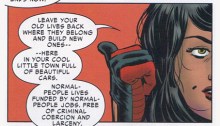
The hope of the new Spider-Woman series.

In which my preference switches between the two series. Fast and funny beats turgid “commentary.”

Reading these two comics together that stand (let’s call it) 40 years apart, I can’t help but wonder if the versions of Howard I saw in previous issues somehow flipped across time and space to take each other’s place.
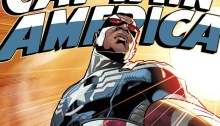
Sam Wilson’s characterization as the rugged individual and then his ascension to the role of Captain America are political messages that must be addressed beyond the tendency of media to oversimplify the political ramifications of things, or streamline complex histories

The first in a series of posts about both the new and original Howard the Duck comic book series.
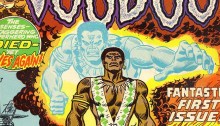
The fourth in a series of posts about black superheroes. Marvel Comics’ Brother Voodoo—a character to feel really conflicted about.
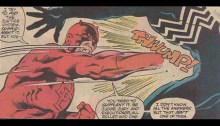
In this story, Spider-Man and Daredevil demonstrate a hegemonic framework for understanding urban crime (part of SUPER BLOG TEAM-UP #4).

Do alternate dimensions and the flow of time in superhero comics confuse and complicate issues of sex and consent?
If there is one thing we can count on in mainstream superhero comics it is the strange tension between the accretion of change and the status quo.

This is Part Two of a two-part series of posts on the classic X-Men comics arc, “Days of Future Past.”

This is Part One of a two-part series of posts on the classic X-Men comics arc, “Days of Future Past,” which originally appeared in X-Men issues #141 and #142.

X-Men’s record of including women is still only good in relation to the rest of superhero comics.

The first major story arc in DeConnick’s series is an attempt to write Ms./Captain Marvel into a revisionist feminist text – a laudable attempt to make manifest the purported feminist subtext of the character.

At the heart of Dan Slott’s run on She-Hulk is a alternately critical and nostalgic concern with continuity and rupture in serialized superhero comic books.

The very idea of a traditional family is a delusion.

Matt Fraction’s Hawkeye takes place in Bed-Stuy, but where are the black people?

The generic “human” these robots want to be is a white human.

Black Goliath is a title that never got a chance to really develop and it suffers from the problems of a lot of early attempts to bring ethnic characters into the limelight.
 The Middle Spaces